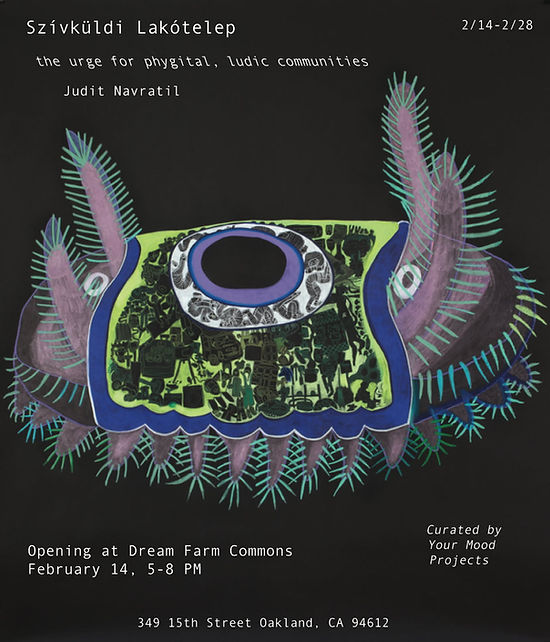
Szívküldi Lakótelep: the urge for phygital, ludic communities
Judit Navratil's exhibition
February 14 - 28
Curated by Selby Sohn + Your Mood Projects
February 14 5-8 pm
OPENING PERFORMANCE LECTURE
AND DREAMY SURPRISES
WITH MIGUEL NOVELO & THE JUNCTION KEEP
February 28 4-6 pm
CLOSING CONVERSATION
WITH VANESSA CHANG AND CASSIE THORNTON
These past three years, Navratil has worked on her artistic research PhD, which she defended in a presentation in Vienna in December, successfully. Szívküldi Lakótelep: the urge for phygital, ludic communities traces her long-term, practice-based inquiry into digital belonging and topophilia. It engenders community-making across social VR through embodied, participatory forms. Judit’s PhD is framed by her experience as an immigrant in continuous transit and movement.
The Reflexive Document is structured as a series of Long Distance Somersaults moving through möbius loops, circling around questions of home, play and care across phygital space. The exhibition serves as the layered, spatial constellation. The base of this research unfolds as an embodied inventory that comes into full articulation through her performance lecture as a living, connective whole.
February 14 5-8 pm
OPENING PERFORMANCE LECTURE AND DREAMY SURPRISES WITH MIGUEL NOVELO AND THE JUNCTION KEEP
Judit Navratil is presenting her PhD thesis in a solo show curated by Selby Sohn + Your Mood Projects at Dream Farm Commons.
The opening takes the form of Judit’s performance lecture, and dreamy surprises like Miguel Novelo’s Sueños Wajiros, and seeping love to our neighbors with The Junction Keep, a mobile public art experience that brings light to crosswalk safety.
5:30 Judit's performance lecture
6:30 Miguel Novelo's Sueños Wajiros
During the opening, The Junction Keep’s mobile sculpture transforms 15th Street and the neighborhood’s intersections into illuminated spaces of connection, memory, and mindfulness.
https://www.juditnavratil.com/
https://yourmoodprojects.com/
Saturday Gatherings
FEBRUARY 21 1-6 pm
Movement workshops & sound baths with Mana and Leylah
RSVP 1-3 PM
RSVP 4-6 PM
February 28 4-6 pm
CLOSING CONVERSATION WITH VANESSA CHANG AND CASSIE THORNTON
Join us for a conversation that situates Vanessa Chang’s new book, The Body Digital within the lived practices of phygital care, digital belonging, and community resilience explored in Judit Navratil’s artistic research and Cassie Thornton’s collective care infrastructures. Together they consider how bodies, technologies, and nomadic social relations intertwine: how digital environments shape affect and embodiment, how communities hold one another through dizzying transitions, and how we might cultivate tenderness, responsibility, and shared agency in the age of accelerating AI. Hosted within Navratil’s solo exhibition, this event extends her inquiry into compossible spaces, cyber-topophilia, and exploring what kinds of communities we might need to feel at home in the future.
https://www.vanessa-chang.com/
http://feministeconomicsdepartment.com/
CURATORIAL STATEMENT
BY SELBY SOHN
"As Judit writes, topophilia, derived from the Greek works ‘topo’ (place) and ‘philia’ (love), refers to the affective bond that we have with a place. Throughout my relationship with Judit — meeting online and in stunning natural settings — I have fallen in love with places again and again. I have also fallen in love with collective gatherings. Belonging typically refers to a borderline, outlining inclusion and exclusion. In her PhD, Judit quotes Dana Segev, an independent researcher in social sciences, who redefines belonging not as a static state but as movement itself, something dynamic, fragile, and constantly negotiated. Judit agrees. She reframes belonging through ‘compossible space,’ a concept about the intermingling of conflicting elements, which, Judit argues, allows for the confusing. As we have seen, again and again, in her VR art camp and in-person gatherings, new ideas and experiences emerge when we allow for the coexistence of disparate elements.
Upon leaving Judit’s gatherings, I have felt both alive and awakened, filled to the brim with catharsis and connection, and uncomfortable and challenged, asking myself the most difficult questions. Both experiences, for me, are invaluable. Judit sees herself not just as a mother, but also as a grandmother, shepherding us into an unknown future. As online spaces hijack our attention and sociability, and as politics and corporations continue to trap and exploit us, asking ourselves how we can gather differently and mobilize feels like not just a critical question, but the most important one. What are the ways in which we can reconfigure our world so we can see ourselves, our places, and each other differently?
Let us find new paths, new beings, new conversations, and a new love for our surroundings. Let us find phygital spaces, ludic activities, situated learning, and play as resistance to ordinary life. Let us somersault into the future."